In Focus: Custom-made lighting objects for individual spaces. Conversation with PrintYourLight.
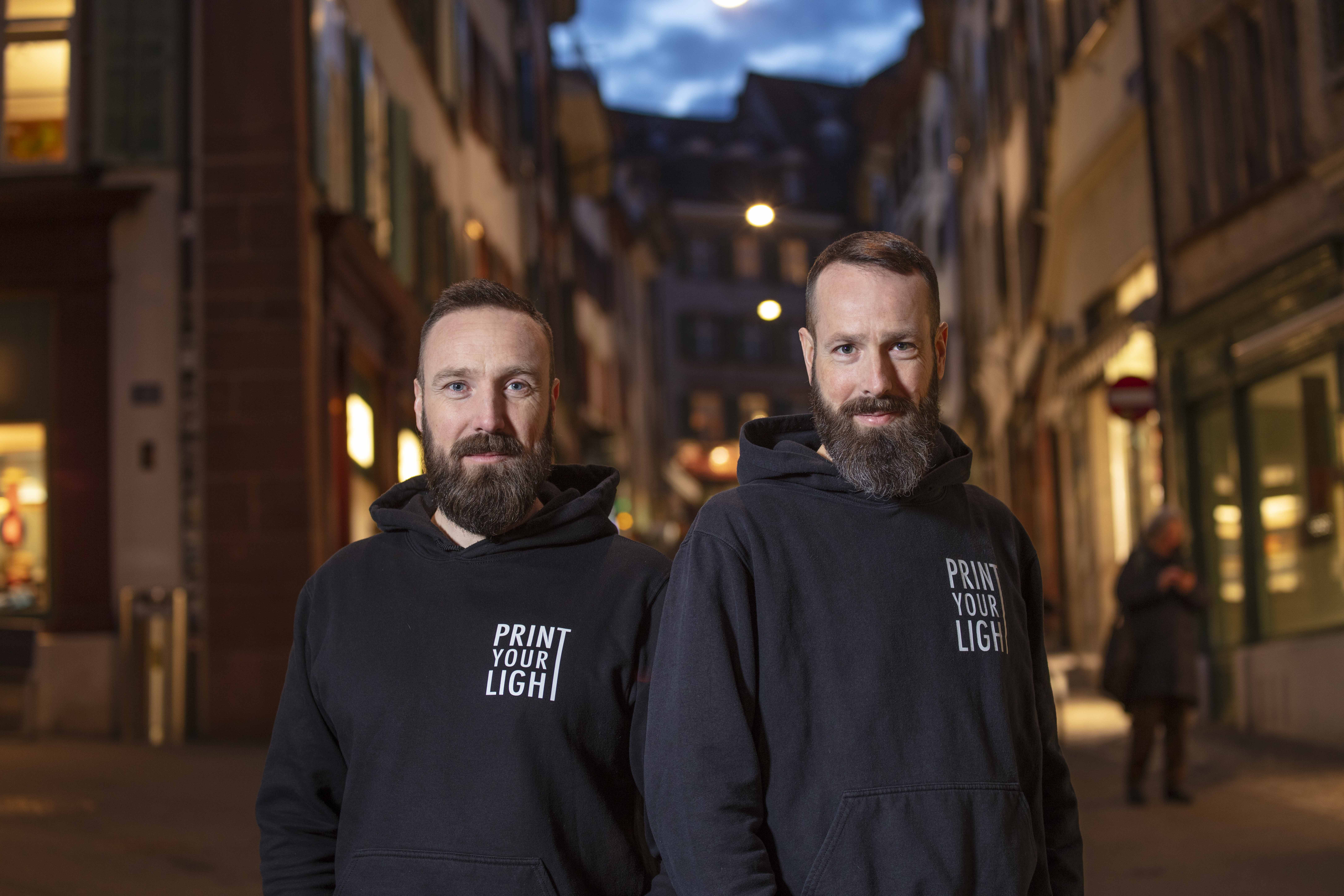
How are lighting fixtures created that go far beyond their function as sources of light and become an extension of a space’s architecture? In conversation with the founders of PrintYourLight, we discuss the influence of architecture, nature, and co-design on their work, the possibilities of 3D printing, and the role of light as an identity-defining element of design.
Anna Stärk
22. June 2026
Share article
Bevor wir Ihnen YouTube-Videos zeigen können, müssen wir Sie darüber informieren, dass beim Laden der Videos möglicherweise Daten an den Anbieter übermittelt werden. Mit dem Klick auf den Play Button akzeptieren Sie die Erhebung und Verarbeitung dieser Daten gemäß unserer Datenschutzerklärung.
Bevor wir Ihnen Vimeo-Videos zeigen können, müssen wir Sie darüber informieren, dass beim Laden der Videos möglicherweise Daten an den Anbieter übermittelt werden. Mit dem Klick auf den Play Button akzeptieren Sie die Erhebung und Verarbeitung dieser Daten gemäß unserer Datenschutzerklärung.
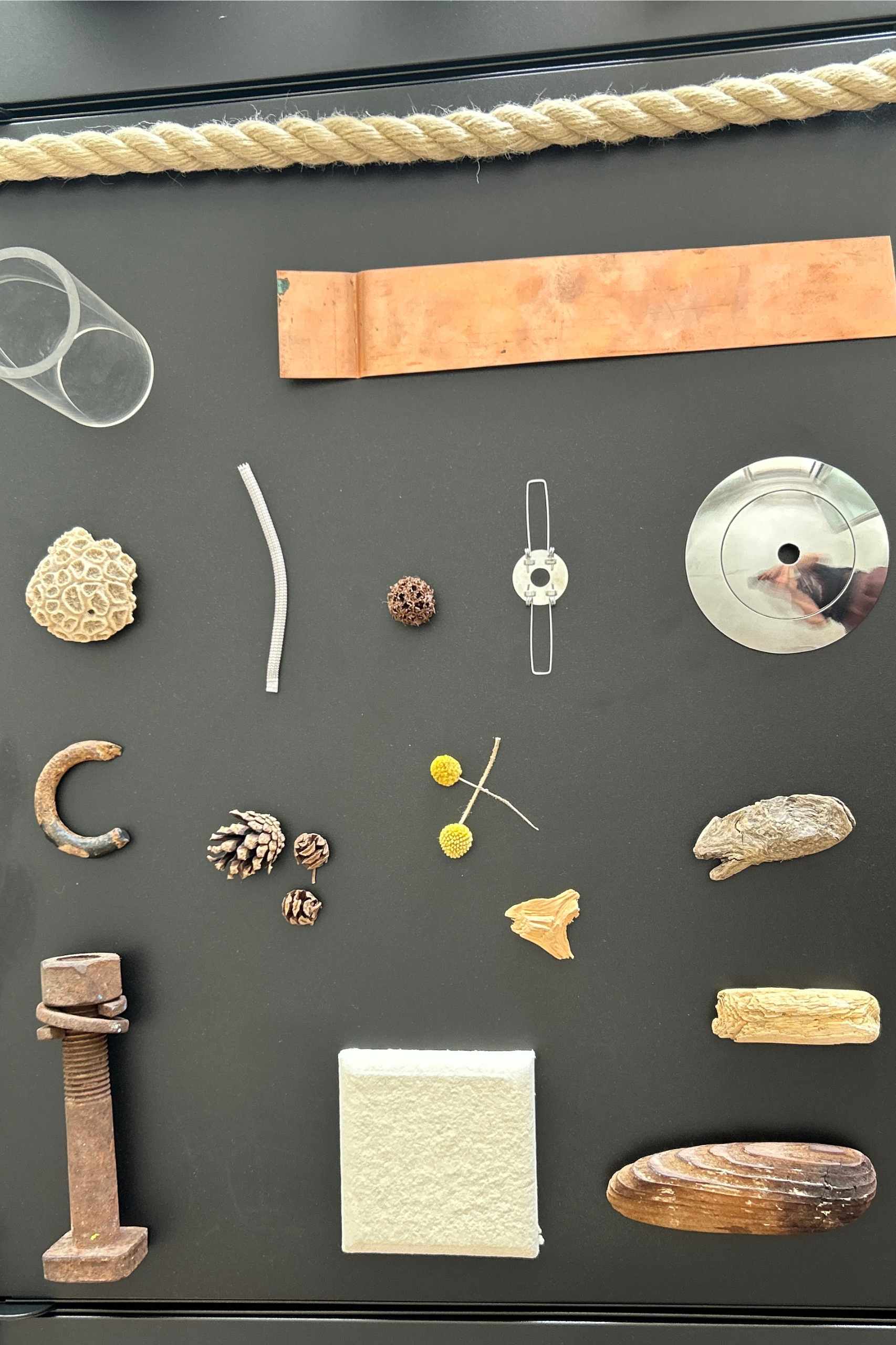
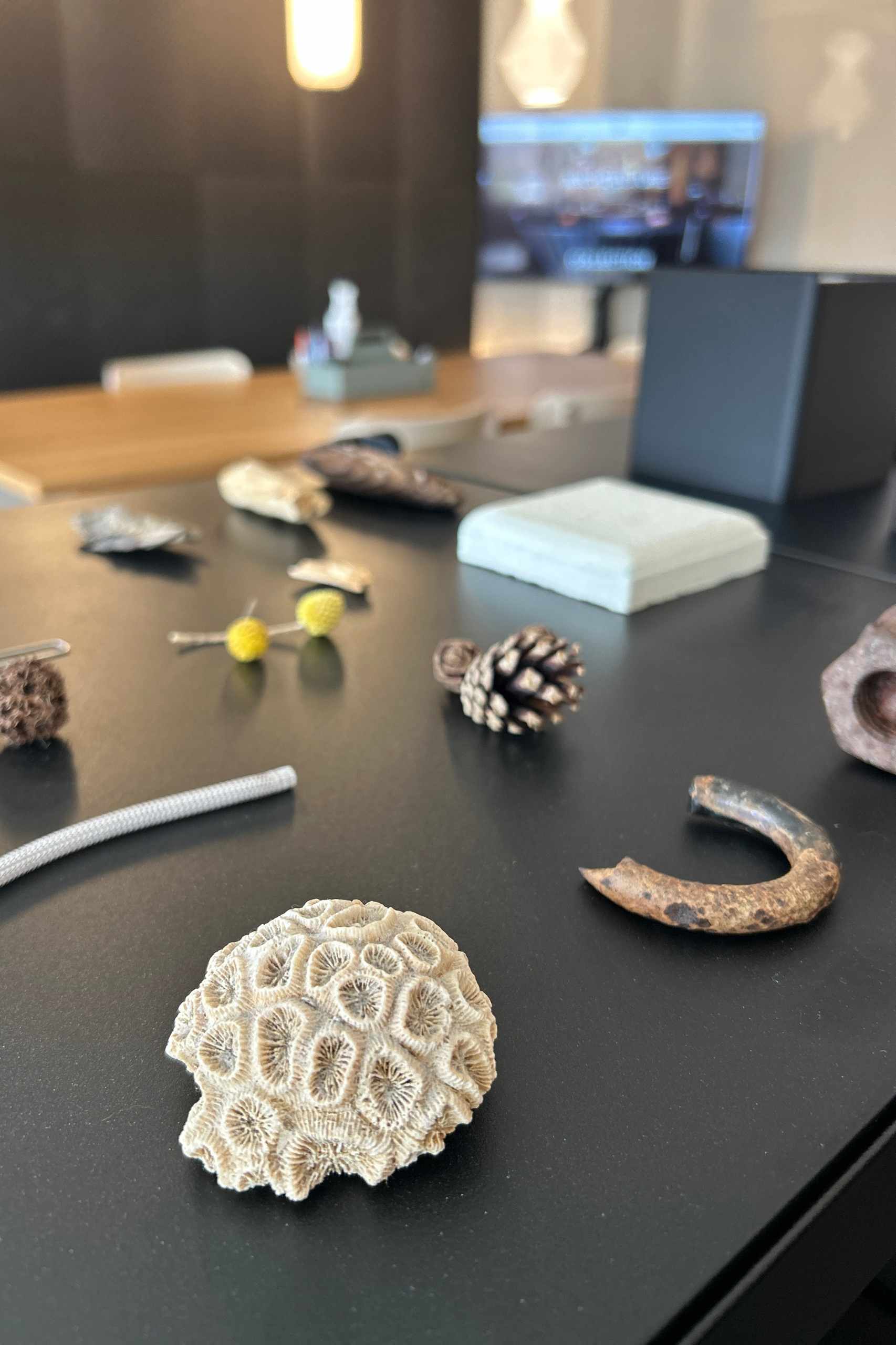
Your luminaires feel less like conventional lighting fixtures and more like spatial objects. Are there influences beyond traditional product design – such as art, fashion, or architecture – that particularly inspire your work? PYL: That observation captures the essence of our work. And yes, we are certainly shaped by influences from outside our field. We follow the trends we encounter at design fairs, and above all, we are inspired by nature and its organic, cellular forms. What truly matters, however, is how we translate these impressions. We never begin with a predetermined design language, but always with the specific context: the client, the place, the project, and the idea behind it. Art, architecture, and design are part of the conversation from the very beginning, because every object is created in close collaboration with architects, interior architects, lighting designers, artists, and designers, each contributing their own references and perspectives. The form evolves through an iterative co-design process rather than from a preconceived aesthetic. That is precisely why the results feel more like spatial objects than catalogue products. Every piece reflects the unique character of its own context.
What inspires your design process most – the lighting conditions, the atmosphere of a space, or the needs of your clients? PYL: We rarely begin with a single factor. Instead, every project starts with a narrative that is developed together. Everything else follows from that. Our ultimate goal is to create an atmosphere that defines the space in all its facets, and the interplay between daylight and artificial light plays a central role in achieving this. At the same time, we always think beyond a luminaire's illuminated state. In addition to its different lighting scenarios and dimming levels, every object also has an unlit presence. It must exist as a sculptural element within the space even when switched off. This physical presence is just as important to us as the quality of the light itself. The result is an object that shapes a space whether it is illuminated or not. Our clients' needs are not a separate consideration – they are an integral part of that narrative.
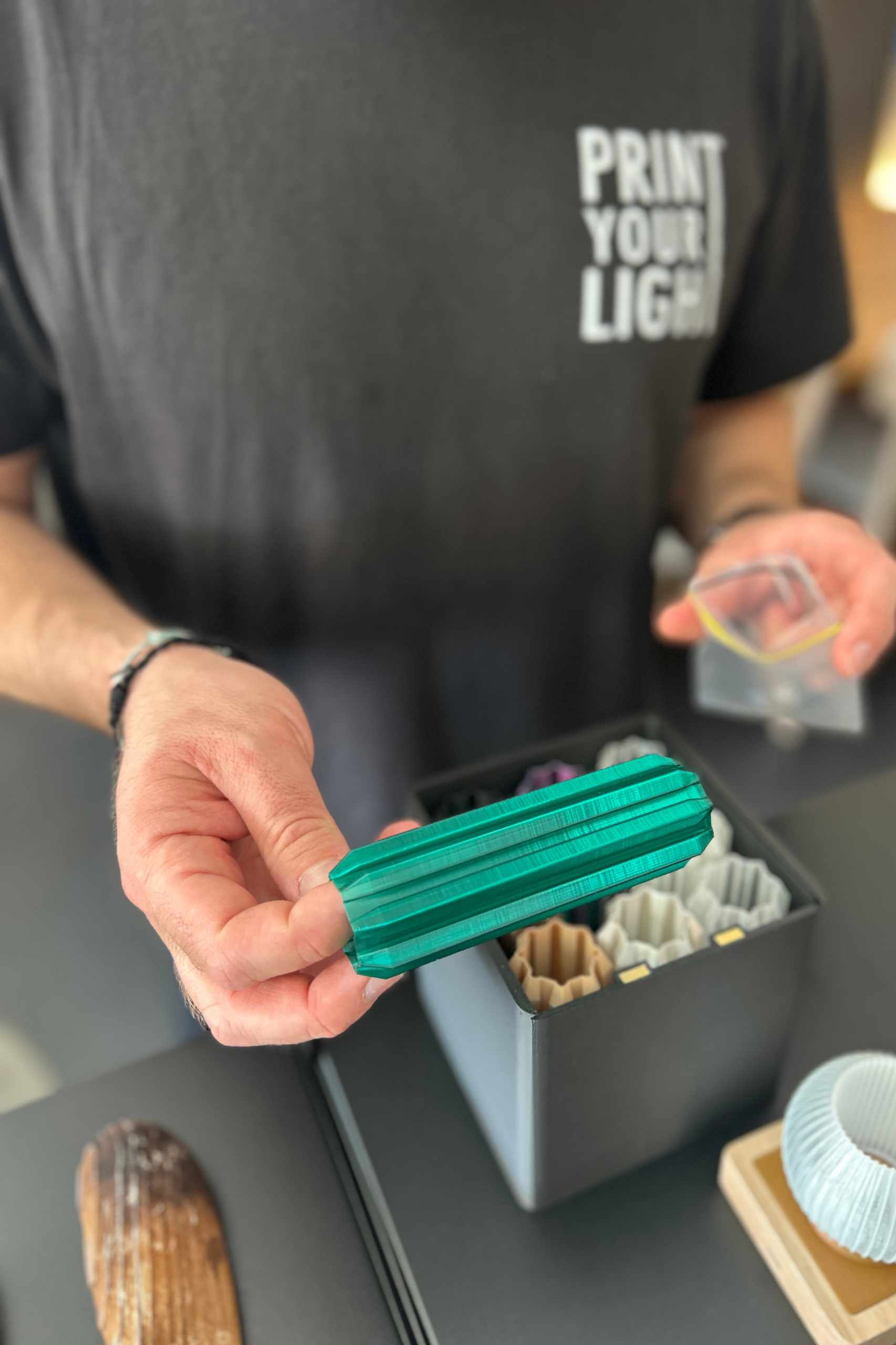
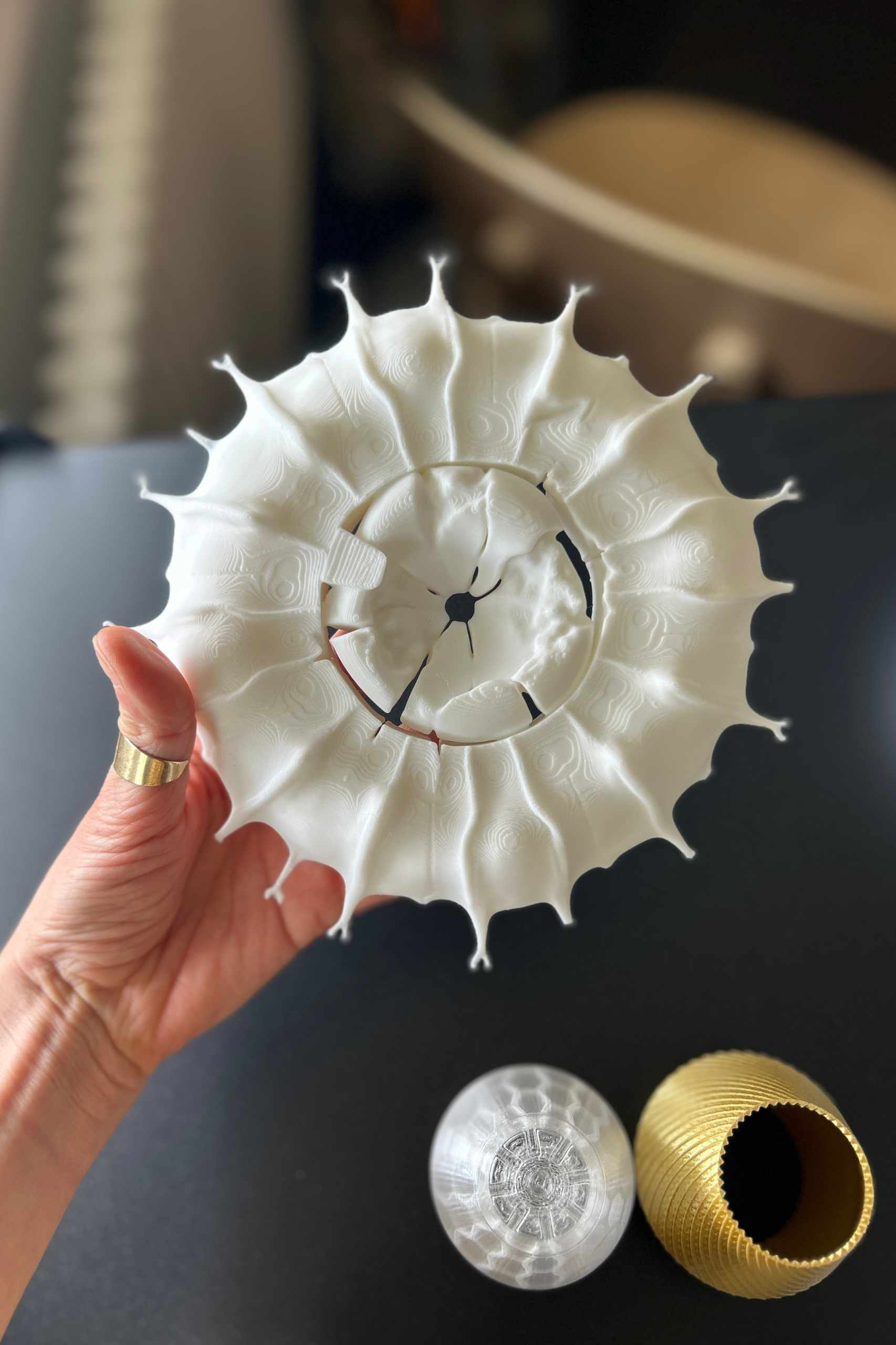
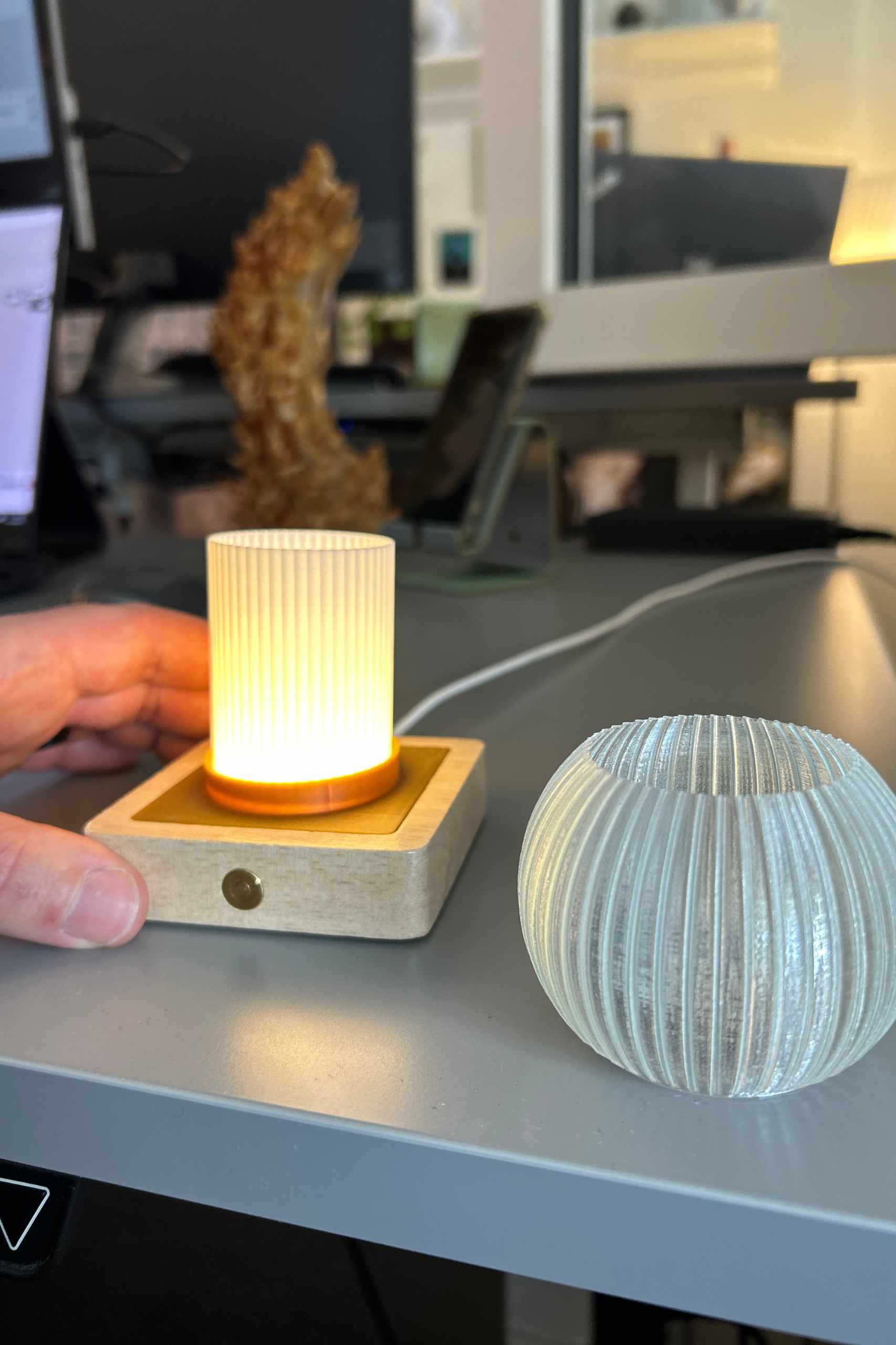
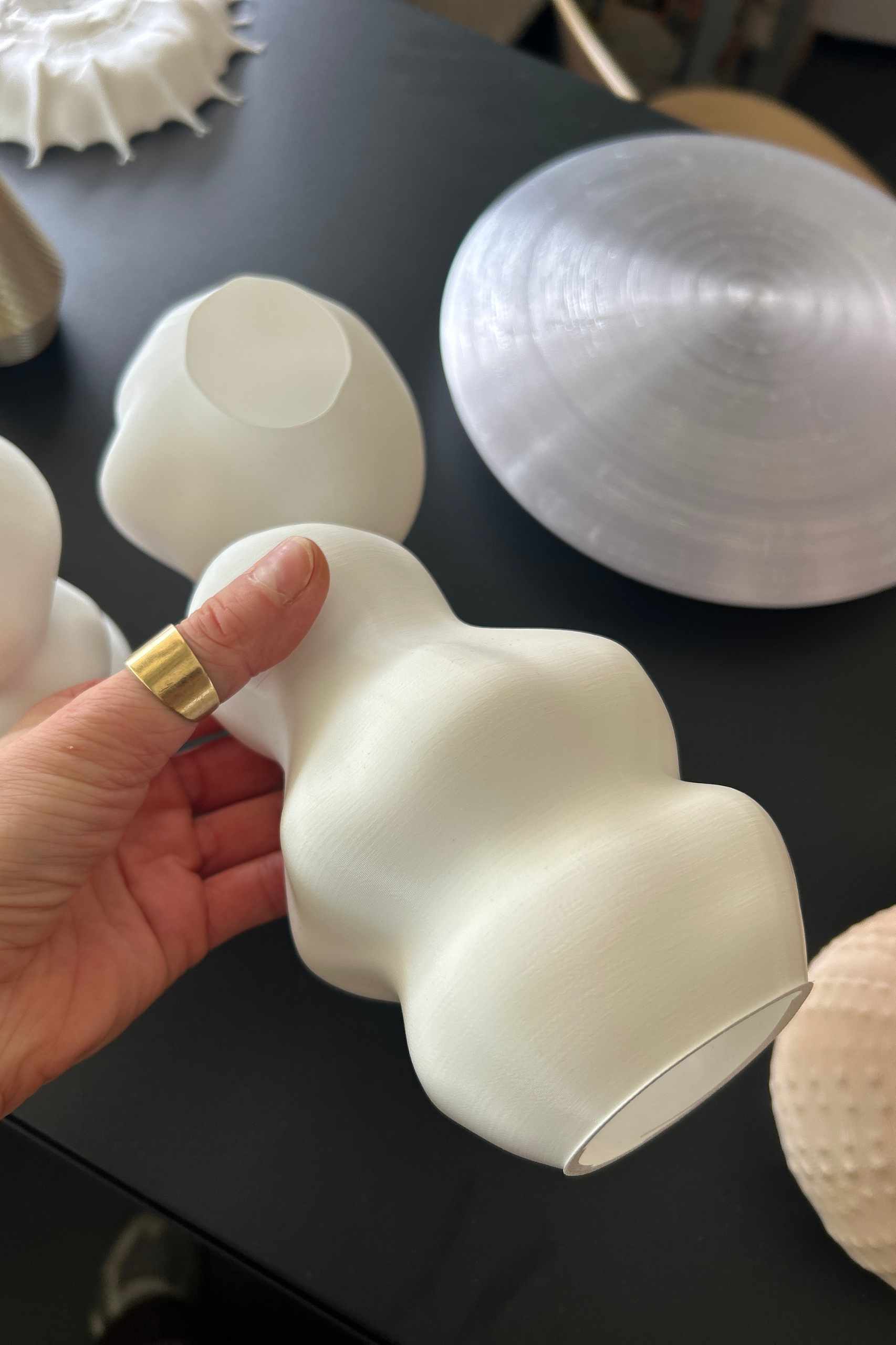
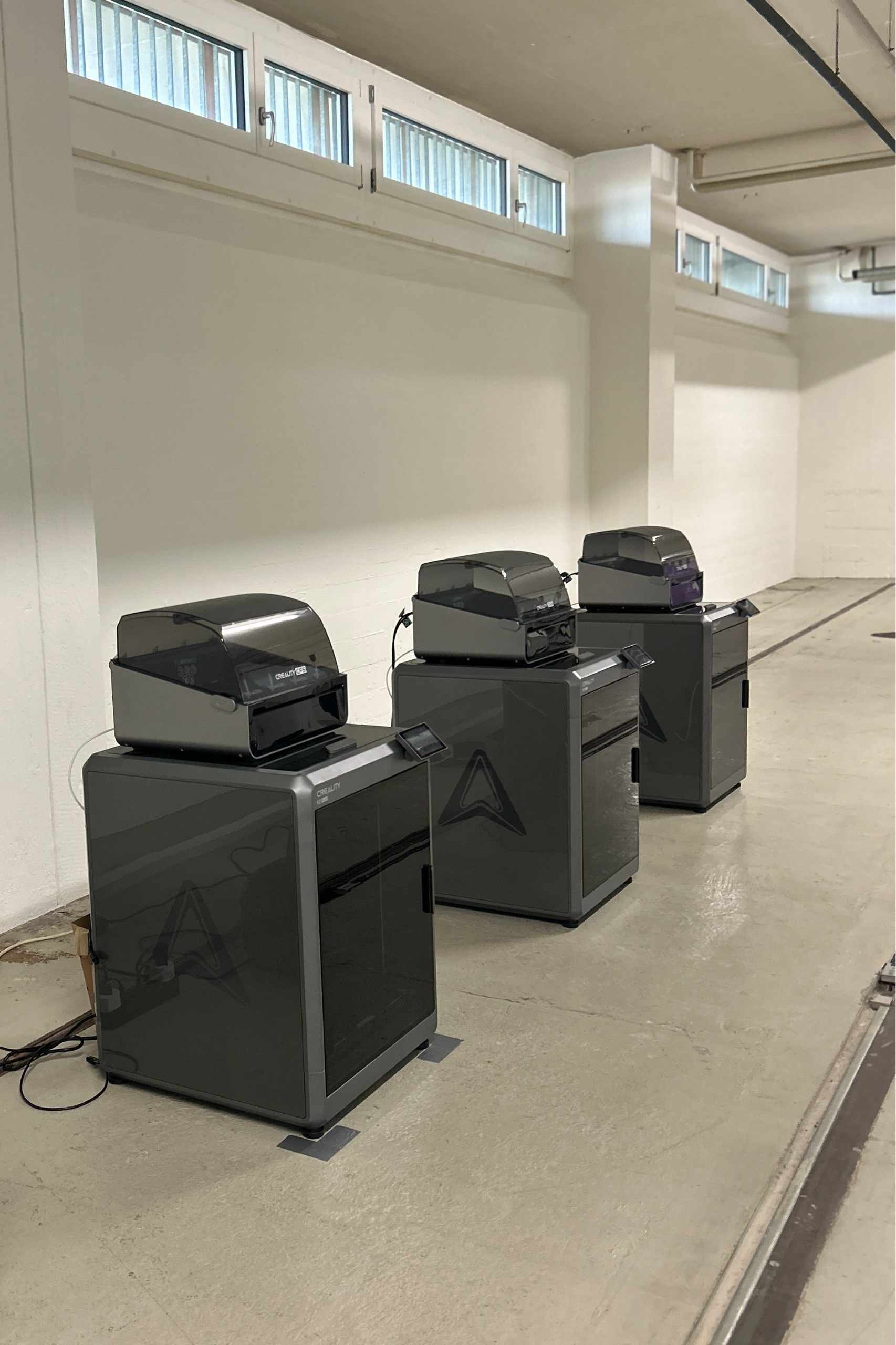
What does your design process look like? Is there a recurring workflow? And what typically takes longer – the design phase or the production? PYL: Yes, there is a recurring process, although every project reaches a different outcome. At its core is an iterative co-design approach, in which ideas are continuously refined within an interdisciplinary team. Thanks to our 3D-printing capabilities, we can produce physical prototypes very quickly. These prototypes enable rapid iterations, allowing clients to actively shape the development process until the final result matches the shared vision. By far the largest portion of time is spent on development. From the initial idea to the finished product, the process typically takes ten to twelve weeks. Production time depends on the size and quantity of the pieces, but with 3D printing it is considerably shorter than with conventional manufacturing methods. We produce anything from a single bespoke piece to runs of around one hundred units.
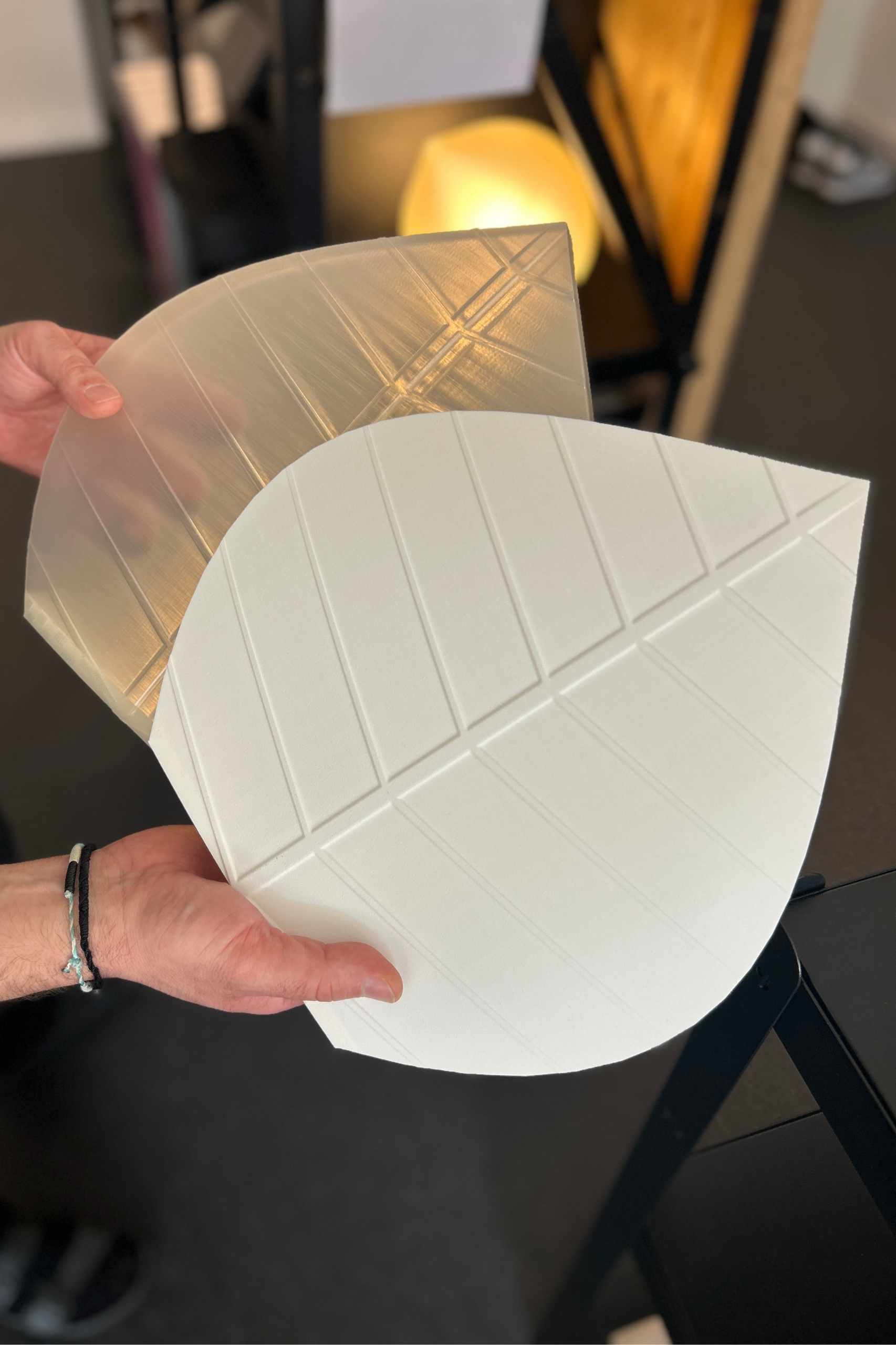
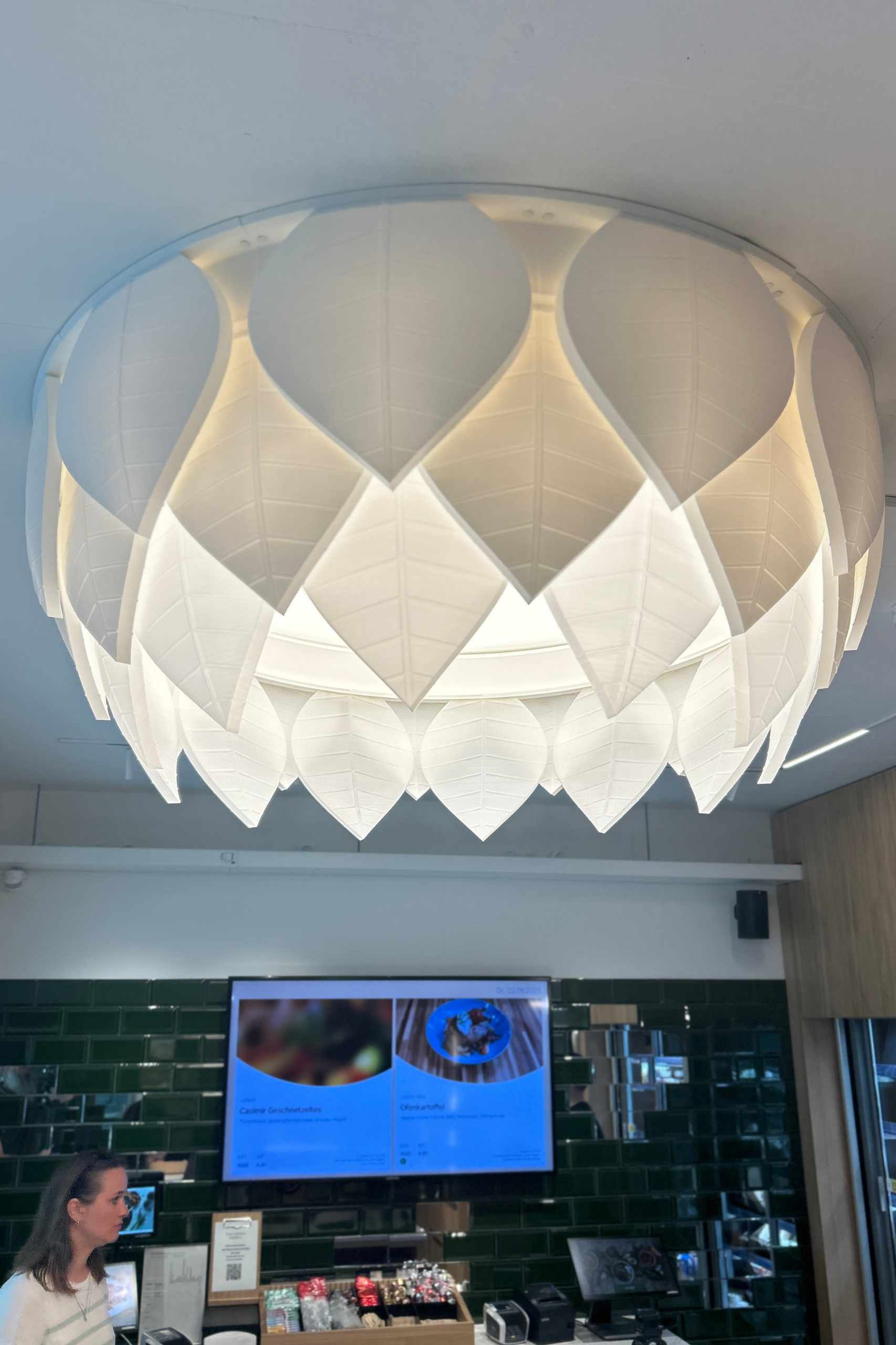
The luminaire we created together immediately defines the space. What role do you think such a statement piece plays in architecture and interior architecture today? PYL: Today, a successful statement piece is much more than decoration – it gives a space orientation, identity, and presence. That was exactly the objective in our joint project. The kiosk was set back from the street and was simply overlooked by most passers-by. The team at Blaser Architekten approached us with the idea of making this area more visible and inviting. Light is the ideal medium for this because it guides, signals, and creates atmosphere at the same time. As is often the case, the brief evolved during the project, and together we decided to create a statement piece. The result demonstrates how precisely space, material, and light must work together to create such a striking focal point. That is exactly what we achieved in collaboration with Blaser Architekten.
How important is collaboration with architects and interior architects in your design process? Do the strongest ideas emerge through dialogue or from a clear creative vision? PYL: Collaboration with architects and designers lies at the heart of our design process. Most projects begin with a clear creative vision, and that vision provides an essential direction. Its real strength, however, emerges through dialogue – when it meets our experience and the specific conditions of the project. This is where 3D printing gives us a significant technical advantage. Because we do not rely on injection moulds that permanently fix a design, ideas can evolve, expand, and adapt throughout the project, just as the brief itself often changes. The strongest results almost always emerge where vision and dialogue reinforce one another rather than compete.
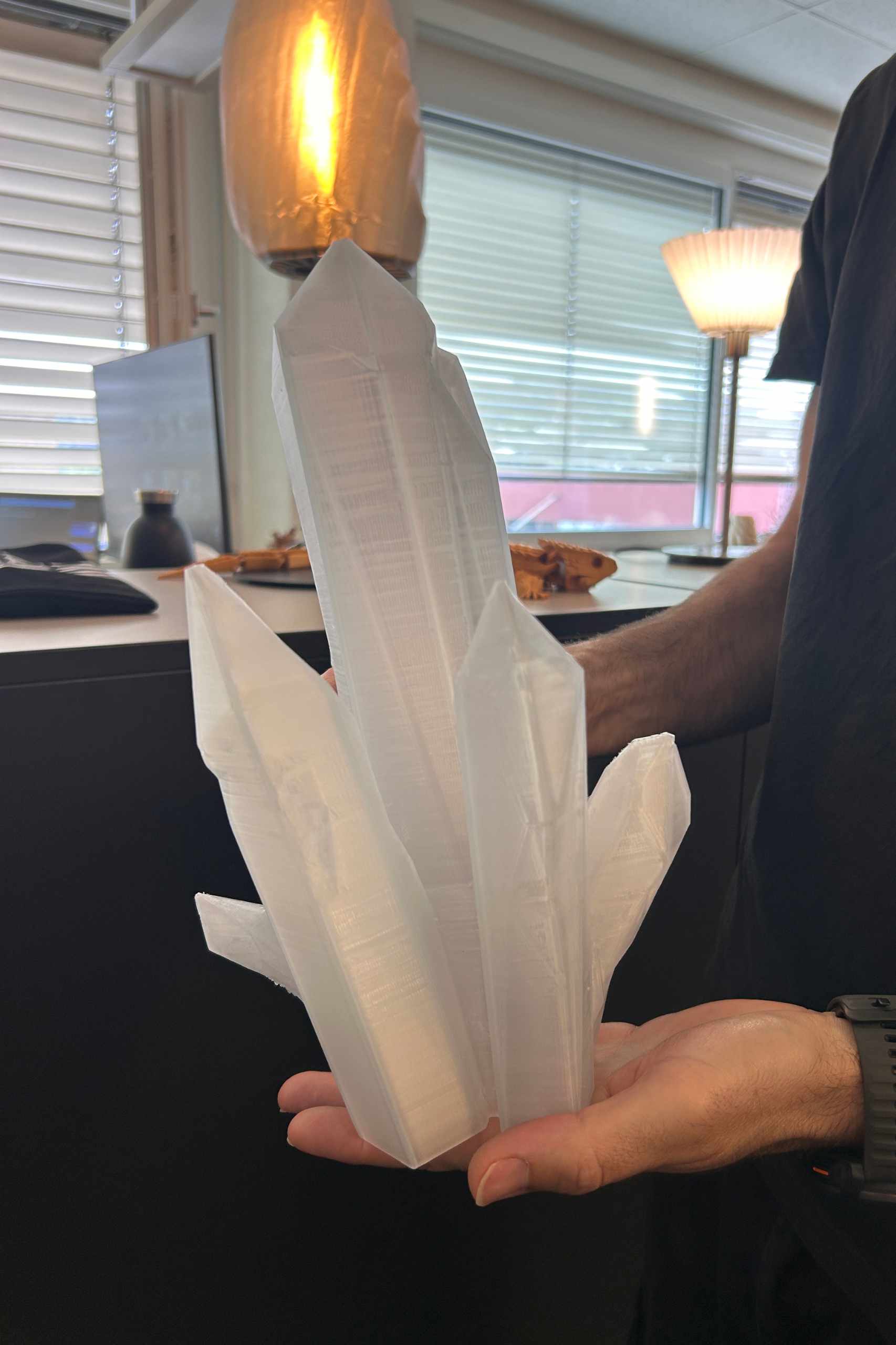
Young design brands often face the challenge of balancing individuality with scalability. How can a growing company maintain its own creative identity? PYL: We know this challenge well. For us, however, it is actually our greatest strength. Our ambition is to make the client a co-designer. Unlike traditional manufacturers, where designers define the formal language, the distinctive character of our objects comes from the people we collaborate with, not from us. We contribute our expertise in lighting design, technology, and materials in service of their vision. For us, individuality is therefore not the opposite of scalability – it is the product itself. It extends from the overall project right down to each individual object. One example is the approximately fifty crystal lighting sculptures we developed and produced together with the artist duo Gerda Steiner & Jörg Lenzlinger for Restaurant Banks, each one entirely unique. Scalability is achieved through our production capacity, which grows alongside our projects. In this way, every creative signature remains intact precisely because it is not our own.
Sustainability is becoming increasingly important in product design. What responsibility do contemporary lighting manufacturers have today, both creatively and in terms of production? PYL: For us, responsibility begins not with the material alone but with the entire system. When we founded the company in 2018, our idea was to manufacture bespoke luminaires locally in Basel and produce only what each project actually requires. Without tooling and from quantities as low as a single piece, there is no overproduction. And because we manufacture where the product will ultimately be used, we deliberately avoid long transport routes. The main component of our luminaires is PLA (polylactic acid), a bio-based material free from petroleum that can be returned to the material cycle. In our joint project, sustainability was a key priority for the client, so we used fully recycled PLA. From a design perspective, however, our greatest responsibility is to create objects that people want to keep – because the longest-lasting product is usually the most sustainable one.
Your designs move between geometric precision and experimental forms. How do you balance technical performance with emotional impact? PYL: We do not see this as a balance between two opposing forces but as a prerequisite: one only works because of the other. Every luminaire must meet the highest technical standards, from luminous output and colour rendering to glare control and lighting control systems. No matter how expressive a form may be, it will only succeed in a space if these fundamentals are right. Conversely, a technically perfect luminaire without a compelling design idea remains forgettable. The emotional impact therefore emerges not despite the technology but because of it, once both dimensions support one another. This interplay defines our work, and 3D printing gives us the freedom to push a form as far as a project demands without losing sight of the physical realities.
Light has an enormous influence on the materiality, atmosphere, and perception of a space. Since you primarily work with the same material, does that ever become limiting? PYL: Although we mainly work with the biopolymer PLA in 3D printing, it is available in a remarkable variety of finishes – transparent, in numerous shades of white, opaque or translucent colours, multi-coloured versions, and even materials with wood fibres. This opens up an impressive range of design possibilities. We are especially interested in combining printed elements with materials such as metal, glass, or timber. Often we use a standard metal component, for example, and develop a bespoke printed shade around it. For us, the material is therefore not a limitation but rather a starting point for surprisingly diverse design solutions.
Looking ahead, how do you think lighting design will evolve in the coming years – technologically, aesthetically, and in relation to architecture? PYL: Without question. What excites us most is how lighting will increasingly be conceived and produced. The last major revolution – the transition to LED technology – enabled tremendous advances, including highly compact luminaires with exceptional light output. We believe the next step will not be a new type of luminaire but a new way of thinking: moving away from catalogue products towards objects created specifically for individual spaces and manufactured where they will ultimately be used. That is exactly what 3D printing enables – from one-off pieces to small series, without tooling and without long transport routes. From a design perspective, we are interested in a broader cultural shift. In a world that is becoming ever more digital and ephemeral, physical and enduring objects are gaining value. A luminaire consciously designed for one specific place is the opposite of generic. For us, that represents the most exciting future for the relationship between light and architecture.
Lighting is often considered only at a late stage in the planning process, even though it fundamentally shapes the perception of a space. What would you like architects and clients to change about the way they approach lighting design? PYL: We encounter this situation all too often, and it is unfortunate. Architecture thrives on the interaction of complementary disciplines, and lighting is one of the most powerful among them. It shapes how spaces are perceived, how materials appear, and how people orient themselves. That is why we hope lighting will no longer be treated as an afterthought but considered from the very beginning. Our advice is straightforward: involve a professional lighting designer early in the project, ideally alongside the architectural concept. This allows lighting to become part of the original idea rather than a later correction. The result is better both creatively and economically, and it makes the collaboration far more rewarding for everyone involved.
A large part of our work today is digital and virtual—we design with CAD, enhance plans with BIM data, and visualize projects in 3D. Still, sometimes the tried and true methods prove their worth. Take model making, for example, which continues to play a significant role in architecture. Surprisingly, this might seem counterintuitive given the indispensable tools like 3D renderings and simulations, making physical model making appear almost outdated. However, as in life, the magic often lies in the mix: combining digital and analog methods unlocks unique potential. Why Analog When Everything Is Digital?
Our new blog format REVISITED takes a retrospective look at completed projects, offering an assessment of architecture as it is lived over time. We begin with a single-family home in Witterswil, completed in 2012. Situated at the edge of the building zone, the one-storey residence was realised as a densification of an existing plot and includes, in addition to the customary living areas, a slightly recessed studio space. The house was originally occupied by a couple to whom we have returned for a visit 13 years after their move-in.
In Liesberg, we are currently realising a residential building that deliberately leverages the complex conditions of its hillside location. The clear orientation and carefully positioned openings towards the landscape not only enable impressive long-distance views; the quality of living inside is also enhanced by a sustainable construction approach and integrated building services, designed with the future in mind. We spoke with our client and developer and asked…
With our REVISITED format, we revisit completed projects and ask: How does architecture stand the test of time? Following a single-family house in Witterswil last year, our second visit takes us to Taverne Johann in Basel. More than 20 years after the renovation, Christian and head chef Christoph Hartmann speak again in the video about the interplay between hospitality and space.
Architecture and science – two fields that go hand in hand in the Basel region. These aspects are skillfully intertwined on the MAIN CAMPUS of the Switzerland Innovation Park Basel Area in Allschwil. This life sciences and innovation ecosystem, developed over the past few years near the French border on behalf of Senn Resources AG, offers an attractive and highly interconnected home for companies and institutions ranging from startups to multinational corporations...
Founded in 1993, our office can now look back on a career spanning more than 30 years. 30 years in which we have been able to implement a large number of exciting projects, gain experience and, last but not least, continuously develop ourselves. What has remained the same is the passion for our profession and the unconditional thirst for knowledge and the will to share it, because more than ever we believe that it is not about preserving know-how and experience, but about sharing and passing it on - this is the only way to create mutual exchange, progress and participation. Our company claim “sharing experience” is intended to fulfill this desire and is part of our relaunch, which we implemented on the occasion of our 30th company anniversary...
Auch wir bei Blaser Architekten befinden uns mitten in der digitalen Transformation aller Geschäftsabläufe und können von uns behaupten, dass wir bereits vieles umgesetzt haben. Die Digitalisierung ist aber kein Sprint, auch kein Marathon – viel mehr ein Weg, den wir nicht mehr verlassen werden. Laufend werden neue Tools entwickelt, KI wartet in immer kürzer zu werden scheinenden Intervallen mit neuen Möglichkeiten auf. Das bedeutet, dass wir die digitale Transformation nicht als Prozess verstehen, der nun bald abgeschlossen sein wird, sondern als selbstverständlich gewordener Teil unserer täglichen Aufgaben. Deswegen ist es uns wichtig, diesen Weg aufmerksam zu gehen, was heute möglich ist zu implementieren, aber auch neue Entwicklungen nicht zu verschlafen. Einer unserer Mitarbeitenden ist in diesem Thema besonders zuhause und legt sich dafür ins Zeug. Zamri Thüring ist Student des Master-Studiengangs in Virtual Design and Construction (VDC) an der FHNW und arbeitet bei Blaser Architekten in der Qualitätssicherung für Computer Aided Design (CAD, QS). In diesem Blogbeitrag teilt er seine Erfahrungen und Einsichten.
Press Release. After 20 years at the helm of the Board of Trustees of Architektur Dialoge, Christian W. Blaser has stepped down as President. With the transition to a rotational chairmanship within the board, the foundation is reorganising its structure while continuing its established event series and maintaining a focus on the foundation’s future development.
Founded in 2006, the non-profit foundation Architektur Dialoge (AD) aims to raise public awareness about architecture and urban issues while fostering dialogue between the industry and private users. To achieve this, Architektur Dialoge offers a wide range of events on architecture and building culture, inviting the public to learn more through lectures, guided tours, and workshops. One of these offerings is the Making Of series, which provides insights into craftsmanship and architecture. Hosted by Christian W. Blaser, a member of the AD Foundation Board, the series not only highlights completed projects but also tells the stories behind their creation—from the initial idea to their realisation...
Lorem ipsum dolor sit amet, consectetur adipiscing elit, sed do eiusmod tempor incididunt ut labore et dolore magna aliqua. Ut enim ad minim veniam, quis nostrud exercitation ullamco laboris nisi ut aliquip ex ea commodo consequat. Duis aute irure dolor in reprehenderit in voluptate velit esse cillum dolore eu fugiat nulla pariatur. Excepteur sint occaecat cupidatat non proident, sunt in culpa qui officia deserunt mollit anim id est laborum.Lorem ipsum dolor sit amet, consectetur adipiscing elit, sed do eiusmod tempor incididunt ut labore et dolore magna aliqua. Ut enim ad minim veniam, quis nostrud exercitation ullamco laboris nisi ut aliquip ex ea commodo consequat. Duis aute irure dolor in reprehenderit in voluptate velit esse cillum dolore eu fugiat nulla pariatur. Excepteur sint occaecat cupidatat non proident, sunt in culpa qui officia deserunt mollit anim id est laborum.
Lorem ipsum dolor sit amet, consectetur adipiscing elit, sed do eiusmod tempor incididunt ut labore et dolore magna aliqua.
Lorem ipsum dolor sit amet, consectetur adipiscing elit, sed do eiusmod tempor incididunt ut labore et dolore magna aliqua. Ut enim ad minim veniam, quis nostrud exercitation ullamco laboris nisi ut aliquip ex ea commodo consequat. Duis aute irure dolor in reprehenderit in voluptate velit esse cillum dolore eu fugiat nulla pariatur. Excepteur sint occaecat cupidatat non proident, sunt in culpa qui officia deserunt mollit anim id est laborum.
Lorem ipsum dolor sit amet, consectetur adipiscing elit, sed do eiusmod tempor incididunt ut labore et dolore magna aliqua.
Lorem ipsum dolor sit amet, consectetur adipiscing elit, sed do eiusmod tempor incididunt ut labore et dolore magna aliqua. Ut enim ad minim veniam, quis nostrud exercitation ullamco laboris nisi ut aliquip ex ea commodo consequat. Duis aute irure dolor in reprehenderit in voluptate velit esse cillum dolore eu fugiat nulla pariatur. Excepteur sint occaecat cupidatat non proident, sunt in culpa qui officia deserunt mollit anim id est laborum.
Image Caption. Lorem Ipsum dolor sit amet
Static and dynamic content editing
A rich text element can be used with static or dynamic content. For static content, just drop it into any page and begin editing. For dynamic content, add a rich text field to any collection and then connect a rich text element to that field in the settings panel. Voila!
Image Caption. Lorem Ipsum dolor sit amet
How to customize formatting for each rich text
Headings, paragraphs, blockquotes, figures, images, and figure captions can all be styled after a class is added to the rich text element using the "When inside of" nested selector system.
Image Caption
Heading H5
Headings, paragraphs, blockquotes, figures, images, and figure captions can all be styled after a class is added to the rich text element using the "When inside of" nested selector system.
What’s a Rich Text element?
Lorem ipsum dolor sit amet, consectetur adipiscing elit, sed do eiusmod tempor incididunt ut labore et dolore magna aliqua. Ut enim ad minim veniam, quis nostrud exercitation ullamco laboris nisi ut aliquip ex ea commodo consequat. Duis aute irure dolor in reprehenderit in voluptate velit esse cillum dolore eu fugiat nulla pariatur. Excepteur sint occaecat cupidatat
“Lorem ipsum dolor sit amet, consectetur adipiscing elit, sed do eiusmod tempor incididunt ut labore et dolore magna aliqua. Ut enim ad minim veniam.” <span class="author">John Doe, Oceanic Airlines</span>
non proident, sunt in culpa qui officia deserunt mollit anim id est laborum.Lorem ipsum dolor sit amet, consectetur adipiscing elit, sed do eiusmod tempor incididunt ut labore et dolore magna aliqua. Ut enim ad minim veniam, quis nostrud exercitation ullamco laboris nisi ut aliquip ex ea commodo consequat. Duis aute irure dolor in reprehenderit in voluptate velit esse cillum dolore eu fugiat nulla pariatur. Excepteur sint occaecat cupidatat non proident, sunt in culpa qui officia deserunt mollit anim id est laborum.
Image Caption
Lorem ipsum dolor sit amet, consectetur adipiscing elit, sed do eiusmod tempor incididunt ut labore et dolore magna aliqua. Ut enim ad minim veniam, quis nostrud exercitation ullamco laboris nisi ut aliquip ex ea commodo consequat. Duis aute irure dolor in reprehenderit in voluptate velit esse cillum dolore eu fugiat nulla pariatur. Excepteur sint occaecat cupidatat non proident, sunt in culpa qui officia deserunt mollit anim id est laborum.
What’s a Rich Text element?
Lorem ipsum dolor sit amet, consectetur adipiscing elit, sed do eiusmod tempor incididunt ut labore et dolore magna aliqua. Ut enim ad minim veniam, quis nostrud exercitation ullamco laboris nisi ut aliquip ex ea commodo consequat. Duis aute irure dolor in reprehenderit in voluptate velit esse cillum dolore eu fugiat nulla pariatur. Excepteur sint occaecat cupidatat non proident, sunt in culpa qui officia deserunt mollit anim id est laborum.Lorem ipsum dolor sit amet, consectetur adipiscing elit, sed do eiusmod tempor incididunt ut labore et dolore magna aliqua. Ut enim ad minim veniam, quis nostrud exercitation ullamco laboris nisi ut aliquip ex ea commodo consequat. Duis aute irure dolor in reprehenderit in voluptate velit esse cillum dolore eu fugiat nulla pariatur. Excepteur sint occaecat cupidatat non proident, sunt in culpa qui officia deserunt mollit anim id est laborum.
Image Caption
Lorem ipsum dolor sit amet, consectetur adipiscing elit, sed do eiusmod tempor incididunt ut labore et dolore magna aliqua. Ut enim ad minim veniam, quis nostrud exercitation ullamco laboris nisi ut aliquip ex ea commodo consequat. Duis aute irure dolor in reprehenderit in voluptate velit esse cillum dolore eu fugiat nulla pariatur. Excepteur sint occaecat cupidatat non proident, sunt in culpa qui officia deserunt mollit anim id est laborum.
What’s a Rich Text element?
Lorem ipsum dolor sit amet, consectetur adipiscing elit, sed do eiusmod tempor incididunt ut labore et dolore magna aliqua. Ut enim ad minim veniam, quis nostrud exercitation ullamco laboris nisi ut aliquip ex ea commodo consequat. Duis aute irure dolor in reprehenderit in voluptate velit esse cillum dolore eu fugiat nulla pariatur. Excepteur sint occaecat cupidatat non proident, sunt in culpa qui officia deserunt mollit anim id est laborum.Lorem ipsum dolor sit amet, consectetur adipiscing elit, sed do eiusmod tempor incididunt ut labore et dolore magna aliqua. Ut enim ad minim veniam, quis nostrud exercitation ullamco laboris nisi ut aliquip ex ea commodo consequat. Duis aute irure dolor in reprehenderit in voluptate velit esse cillum dolore eu fugiat nulla pariatur. Excepteur sint occaecat cupidatat non proident, sunt in culpa qui officia deserunt mollit anim id est laborum.
Lorem ipsum dolor sit amet, consectetur adipiscing elit, sed do eiusmod tempor incididunt ut labore et dolore magna aliqua. Ut enim ad minim veniam, quis nostrud exercitation ullamco laboris nisi ut aliquip ex ea commodo consequat. Duis aute irure dolor in reprehenderit in voluptate velit esse cillum dolore eu fugiat nulla pariatur. Excepteur sint occaecat cupidatat non proident, sunt in culpa qui officia deserunt mollit anim id est laborum.
Bevor wir Ihnen YouTube-Videos zeigen können, müssen wir Sie darüber informieren, dass beim Laden der Videos möglicherweise Daten an den Anbieter übermittelt werden. Mit dem Klick auf den Play Button akzeptieren Sie die Erhebung und Verarbeitung dieser Daten gemäß unserer Datenschutzerklärung.
Bevor wir Ihnen Vimeo-Videos zeigen können, müssen wir Sie darüber informieren, dass beim Laden der Videos möglicherweise Daten an den Anbieter übermittelt werden. Mit dem Klick auf den Play Button akzeptieren Sie die Erhebung und Verarbeitung dieser Daten gemäß unserer Datenschutzerklärung.
Bevor wir Ihnen YouTube-Videos zeigen können, müssen wir Sie darüber informieren, dass beim Laden der Videos möglicherweise Daten an den Anbieter übermittelt werden. Mit dem Klick auf den Play Button akzeptieren Sie die Erhebung und Verarbeitung dieser Daten gemäß unserer Datenschutzerklärung.
Bevor wir Ihnen Vimeo-Videos zeigen können, müssen wir Sie darüber informieren, dass beim Laden der Videos möglicherweise Daten an den Anbieter übermittelt werden. Mit dem Klick auf den Play Button akzeptieren Sie die Erhebung und Verarbeitung dieser Daten gemäß unserer Datenschutzerklärung.
Bevor wir Ihnen YouTube-Videos zeigen können, müssen wir Sie darüber informieren, dass beim Laden der Videos möglicherweise Daten an den Anbieter übermittelt werden. Mit dem Klick auf den Play Button akzeptieren Sie die Erhebung und Verarbeitung dieser Daten gemäß unserer Datenschutzerklärung.
Bevor wir Ihnen Vimeo-Videos zeigen können, müssen wir Sie darüber informieren, dass beim Laden der Videos möglicherweise Daten an den Anbieter übermittelt werden. Mit dem Klick auf den Play Button akzeptieren Sie die Erhebung und Verarbeitung dieser Daten gemäß unserer Datenschutzerklärung.