

%20(3).jpg)
Territory as a Cultural Framework. Territory is not a neutral backdrop upon which architecture can be placed at will. It is a complex framework of landscape, settlement, infrastructure and human appropriation. More than a geographical space, it represents a living environment shaped by cultural, ecological and social forces, where nature, society and the built environment continuously influence one another.
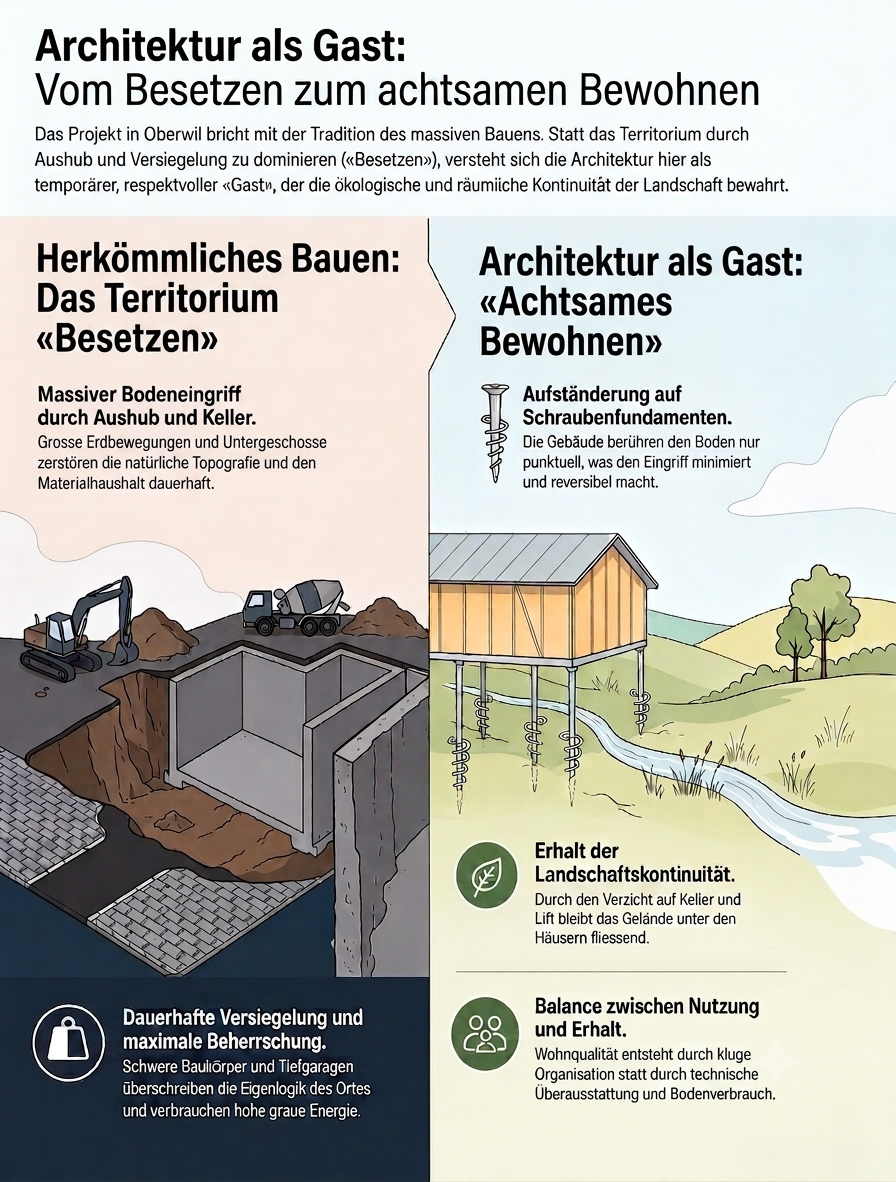
Architecture therefore always operates within a broader context. Every intervention becomes part of an existing network of relationships and carries responsibility towards the place itself, its natural environment, its resources and the people who inhabit it. The central question of our proposal was therefore: How can the necessary densification of our built environment be achieved without depriving a place of its identity through excessive transformation? Or, put differently: How can we establish an Architecture as Guest that inhabits the territory with presence, yet without domination?
The answer does not necessarily lie in refusing to build. Rather, it lies in an attitude of precision, restraint and careful consideration. If territory is understood as a sensitive structural framework, designing means first and foremost reading what already exists, minimising intervention and developing the inherent qualities of a place.
Our proposal for the Living and Dwelling in Sonnenfeld project is grounded in precisely this approach:
- No basement construction and no lifts: By deliberately omitting these elements, we avoid the extensive excavation that, in conventional developments, irreversibly disrupts the ecological balance of the soil.
- Elevated construction: Raising the buildings above ground reduces soil sealing to an absolute minimum, allowing the landscape to continue uninterrupted beneath the structures.
- Screw pile foundations instead of concrete slabs: Rather than suffocating the ground beneath large concrete foundations, the buildings are anchored only at carefully defined points.
The buildings touch the ground only where necessary, behaving like respectful guests within the landscape – present, yet never dominant.
Sufficiency: Achieving More with Less. This way of building is not merely a technical or constructive strategy; it expresses a particular understanding of dwelling. Living, in this context, does not mean taking complete possession of the land, but becoming part of an existing cultural landscape. Because almost every landscape has already been shaped by human activity, every new intervention demands an awareness of proportion, respect and appropriateness.
At Sonnenfeld, this attitude becomes spatially tangible. Rather than seeking complete control over the site, the architecture strives for a balance between use and preservation.
The decision to forgo basement storage and an underground parking garage follows the same logic. Features that have become standard in conventional residential construction require substantial interventions into the ground, the topography and the material cycle. Eliminating these components not only reduces construction costs and embodied carbon, but also encourages a more conscious relationship with space and material possessions. Alternative solutions – such as decentralised storage units, utility rooms and generous outdoor spaces – demonstrate that residential quality does not depend on technical over-equipment, but on intelligent organisation and spatial generosity.
Sustainability as a Design Attitude. The project naturally brings together ecological, economic and architectural qualities. Sustainability is not treated as an additional layer, but as the direct consequence of a design approach that respects the territory. Our proposal demonstrates that density, comfort and identity can be achieved without extensive soil sealing, underground infrastructure or excessive material consumption.
The landscape remains intact, the intervention remains reversible, and architecture becomes part of a larger whole. In doing so, the project formulates a contemporary yet fundamental architectural position: our task is not to occupy territory, but to inhabit it with care.
We are fully aware that such an approach depends on the specific conditions of each individual project and cannot be applied identically in every context. Nevertheless, we regard Architecture as Guest as a guiding principle that informs our thinking, planning and design process at every stage. It is an attitude that continues to shape our work.
.png)

.jpg)
.jpg)

%20(2).jpg)
.jpg)
-min.jpg)
%20(1).jpg)
%20(2400%20x%202400%20px)%20(1200%20x%201080%20px).jpg)

.avif)
