

Blaser Collection
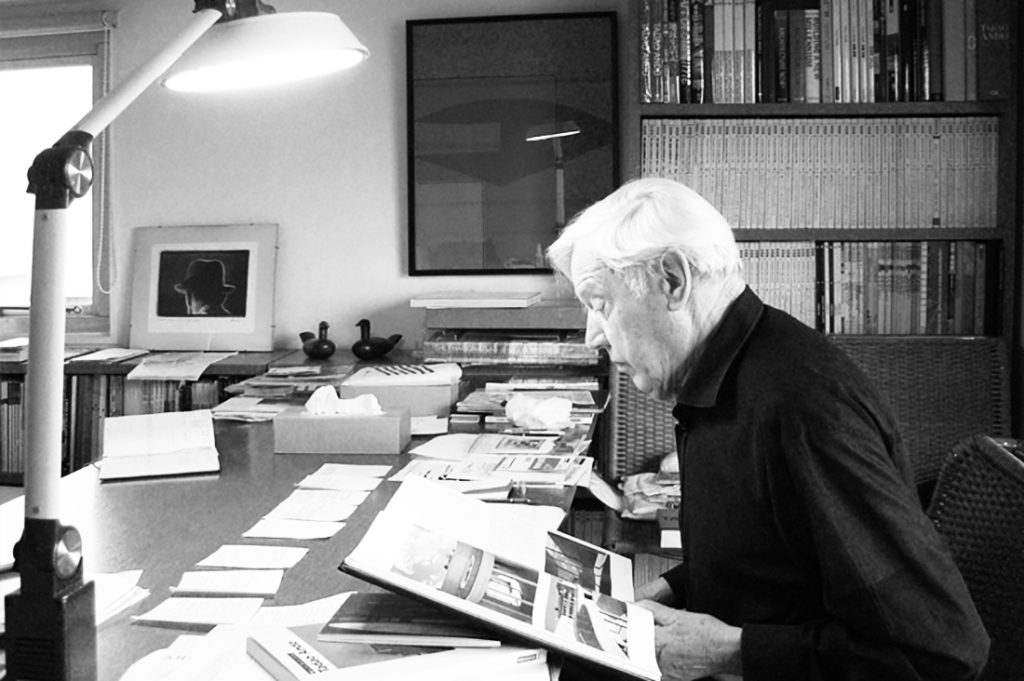
With 100 books, twenty architectural projects, 100 furniture designs and thousands of photographs from journeys around the world, Werner Blaser began, around 2007, together with his son Christian W. Blaser, to develop his “Living Archive”. In contrast to a static archive, the Living Archive is conceived as a dynamic repository of knowledge. It is not intended merely as a collection, but as an active working instrument – a link between past, present and future research, open to new interpretations and associations.
The archive brings together different dimensions of Werner Blaser’s work:
- Architectural photography spanning more than six decades (including works on Ludwig Mies van der Rohe as well as Japanese and Chinese architecture)
- Documentation and study journeys across Asia, Europe and the Americas
- A library of approximately 4,000 books on architectural history
- Original furniture designs and prototypes
- Collections of design classics (including furniture by Gerrit Rietveld)
The Living Archive reflects Werner Blaser’s role as a mediator: architecture should not only be understood as a built object, but as a continuous dialogue between cultures, eras and disciplines. His approach was not to preserve knowledge in a static form, but to continuously activate and communicate it. This vision ultimately led to the initiative of presenting his extensive furniture oeuvre within the exhibition “TeckNow”.
Contact: Christian W. Blaser, Blaser Architekten
Salzberg Collection
- 1978–81 Antique cabinetmaker / restorer (Biondi); co-founder of the Tigel cooperative
- 1981–86 Travels through Peru, North and West Africa; training in biodynamic agriculture
- 1984–87 Restorer at F. Rösli Flaach; restorer at Galerie Koller
- 1988 Independent antique cabinetmaker / restorer
- 1992–94 Havana, Cuba; trumpet studies with Alejandro Pichardo (Buena Vista Social Club)
- 1995 Independent restorer, art projects; “Smooth Tentacles” project, Parkinson’s (Jazz)
- Since 2014 Workshop in Tecknau, former watch factory
- Current: Initiator / co-curator of “TeckNow”
Web: www.salzberg.ch
Galerie Freitag 18.30
Galerie Freitag 18.30 in Aachen is dedicated to contemporary art. Gallery owner Robert Mertens produces large-format photographic works.
The series consists of iconic architectural photographs of works by Ludwig Mies van der Rohe, which also serve as references for the gallery artist Sascha Berretz.
Werner Blaser’s photographic work is characterised by precise observation. His perspective lends the motifs a historical aura while simultaneously drawing attention to construction, the rigorous character of architecture, and its interaction with the surrounding environment. The series will soon be expanded to include Japanese motifs.
Web: www.freitag1830.de
Kerstin Caduff
Kerstin Caduff works under the name Art Cacadu. The starting point of her artistic practice is the reuse of materials from the former watch factory in Tecknau. Found clock components, packaging materials, labels and other remnants are dismantled, sorted and reassembled into new constellations through meticulous manual processes carried out at home.
These often delicate and highly detailed processes evoke traditional forms of craftsmanship historically associated with women’s labour and are translated into an artistic language. The resulting works exist between art objects and functional artefacts.
The project is connected to the emerging association Brockibuda, which aims to promote community-based and social initiatives.
Instagram: @art_cacadu
Löffler ERGO
Löffler ERGO is a German manufacturer of ergonomic seating furniture based in Reichenschwand, Bavaria, and is regarded as one of the specialised premium providers in the field of healthy seating. The company was founded in 1992 by Werner Löffler, driven by the vision of fundamentally rethinking and continuously developing ergonomic sitting.
A distinctive feature of the company is the founder’s exceptional furniture collection. Over several decades, Werner Löffler assembled one of the most extensive collections of historic seating furniture. The collaboration with Swiss architect and designer Werner Blaser underlines the company’s cultural and design-oriented ambition.
Within this collaboration, several furniture pieces were reissued and further developed, creating a link between functional innovation and architectural thinking. Among these projects was the “Sinnfindung” series, presented in the context of Ludwig Mies van der Rohe’s legacy at the Berlin University of the Arts.
Web: Löffler ERGO
Molteni&C
Molteni&C is an internationally leading company in the field of high-end design furniture and part of the Molteni Group, headquartered in Giussano near Milan. Founded in 1934 by Angelo Molteni as a family business, it gradually evolved after the Second World War from a traditional carpentry workshop into a major force in modern Italian design.
In 1955, Molteni participated in the first “Mostra Selettiva” – the international furniture competition in Cantù. The jury included figures such as Gio Ponti, Alvar Aalto and Finn Juhl. The competition played a decisive role in strengthening the international position of the Italian furniture industry.
A major turning point came with the consistent focus on design furniture from the 1960s onwards. The chest of drawers designed by Werner Blaser – a student of Alvar Aalto and assistant to Ludwig Mies van der Rohe – featuring a three-part geometric connector and awarded first prize, is considered an early prototype of modern furniture design.
Since then, Molteni&C has collaborated with internationally renowned architects and designers and is today one of the defining brands of “Made in Italy”. Characteristic features include clean lines, high-quality materials such as wood, glass, metal and textiles, and a focus on durable, functional aesthetics. Today, Molteni&C operates globally with hundreds of showrooms and flagship stores, including in London and New York.
Web: Molteni&C
Mous Lattaf
Mous Lattaf (b. 1963 in Casablanca) is a multidisciplinary artist based in the Basel region, whose practice spans painting, mixed media and kinetic sculpture. His figurative visual compositions combine multiple scenes into layered pictorial surfaces.
In the Basel region, his work has been exhibited at venues including cargobar Basel (“LATTAFOLOGIE”, 2021) and various galleries, and will also be presented as part of Open House Basel at the former Basis Watch factory in Tecknau (“TeckNow”, 7–10 May 2026).
Lattaf lives and works between North Africa and Switzerland.
Spectrum Design
Spectrum Design is a Dutch furniture manufacturer founded in 1941 in Bergeijk. From the 1950s onwards, it developed into one of the defining brands of Dutch modernism and was closely associated with the “Goed Wonen” movement, which promoted modern and functional living.
Under the creative direction of designer Martin Visser, Spectrum became a platform for influential designers such as Gerrit Rietveld and Constant Nieuwenhuys. The furniture is characterised by timeless, often strictly geometric forms and is today regarded as iconic Mid-Century Modern design.
After a period of decline in the 1970s, the brand was later revived and now produces both re-editions of historical designs and contemporary collections. The collaboration with Werner Blaser exemplifies Spectrum’s openness towards international architects and designers.
To this day, the iconic coffee table with glass top and curved wooden base continues to be produced – expressing the balance between lightness and structural logic.
Web: Spectrum Design
Suter & Bult
Suter & Bult continuously develops new narratives while simultaneously circling around traces of history and stories from the past. Their practice engages with form, space and the coexistence of different temporal layers.
The non-colour white repeatedly plays a central role, contrasting with earthy tones such as rust brown and ash grey.
“We build up, remove, uncover and conceal.”
Web: Suter & Bult
.jpg)

.jpg)

.jpg)
%20(2).jpg)

%20(2400%20x%202400%20px)%20(1200%20x%201080%20px).jpg)
.jpg)
%20(1).jpg)
%20(3).jpg)

.jpg)
%20(1).jpg)
.avif)
